HRV is sensitive. That is what makes it useful — it responds to sleep, stress, and recovery — but it also responds to things you do not care about, like whether you were sitting or standing, or whether you had just drunk a coffee.
The good news is that nearly all of that noise is under your control. Consistency matters far more than perfection: a slightly imperfect routine repeated every day beats a perfect one done occasionally.
1. Same time, ideally soon after waking
Your HRV naturally shifts across the day. Measuring at a consistent time removes that swing from your data. For most people, the easiest anchor is shortly after waking — after the bathroom, before coffee, before checking email, before exercise.
If mornings do not work for you, pick another time and stick to it. The baseline only needs you to be consistent with yourself.
2. Same position, every time
Posture changes HRV. Lying down, sitting, and standing all give different readings, because your body has to work differently to keep blood moving against gravity.
Choose one — sitting upright and relaxed is a good default — and use it every time.
3. Breathe normally
This one surprises people. Slow, deep breathing raises beat-to-beat variability, sometimes a lot. That is great as a practice, but during a reading it measures your breathing technique rather than your recovery.
So during the sixty seconds, breathe as you naturally would. Save the slow breathing for afterwards.
4. Rest your finger lightly
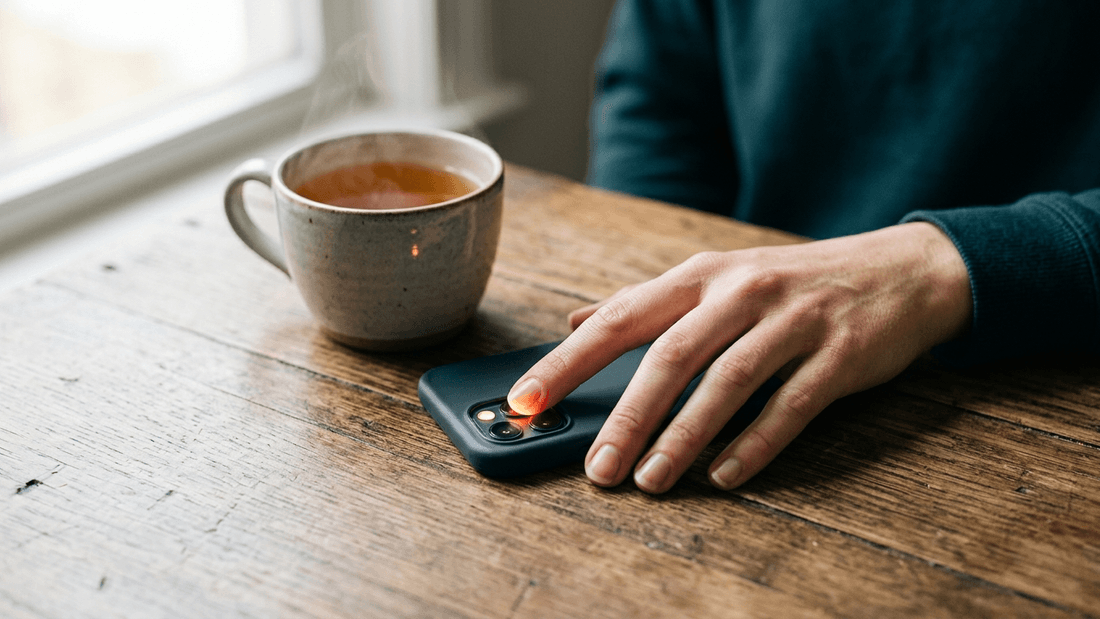
The camera reads the tiny pulse of blood through your fingertip. Pressing hard squeezes those capillaries flat and weakens the very signal you are trying to capture.
Cover the camera and the flashlight completely, with gentle, steady contact — enough to block the light, no more. The app checks contact by colour, so if your finger slips it will tell you.
5. Warm your hands first
Cold fingers restrict blood flow to the skin, which makes the pulse signal faint. If your hands are cold, rub them together or hold a warm mug for a minute before you start.
6. Keep still — rest the phone
Movement is the main source of false beats. Rest your hand, or the whole phone, on a table or on your knee rather than holding it in mid-air. Do not talk during the reading.
7. Skip the reading straight after exercise, caffeine, or a big meal
Each of these legitimately changes your heart rhythm for a while. If you have just done one of them, either wait or accept that today's number reflects it. Better still: measure before any of them.
If the app asks you to retake
Every reading comes with a signal quality check. If the pulse was too faint or irregular to trust, the app will ask for another go instead of recording a misleading number. Warm your hands, lighten your touch, keep still, and try again.
What to expect from your first week
Your first few readings build your personal baseline, so do not read much into any single number yet. After a handful of consistent check-ins, the app starts telling you where each day sits against your own normal — which is where HRV becomes genuinely useful. More on that in What Is a Good HRV Score?
Curious how a phone camera can measure this at all? Read how the fingertip reading works.
Fingertip HRV is free with an account. Get the app and take your first reading tomorrow morning.