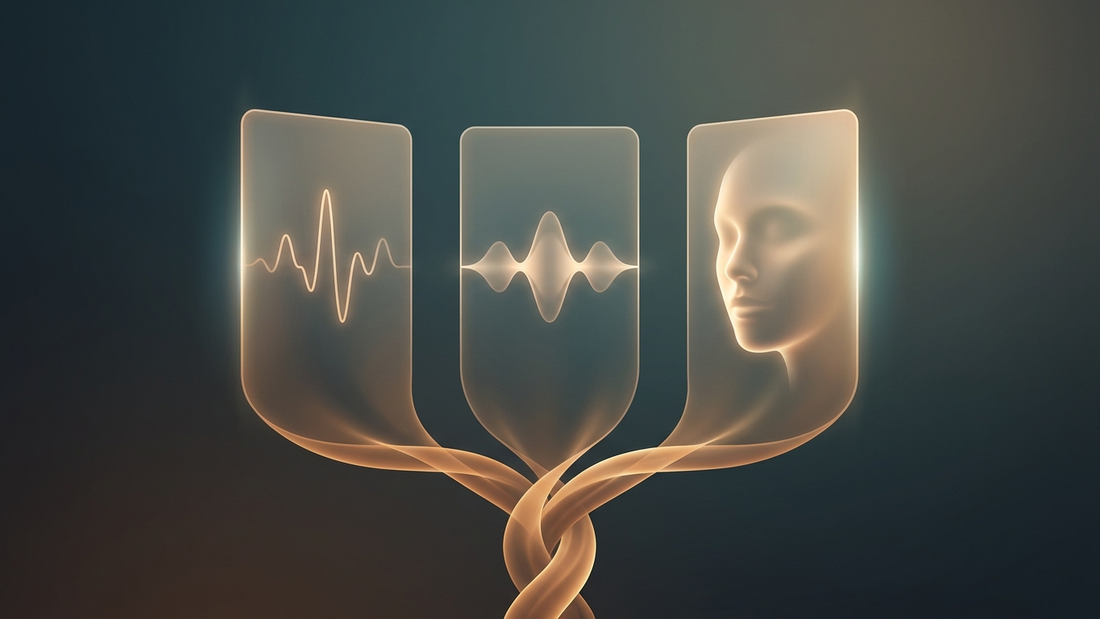
Most health apps measure one thing well. MyUltra.Coach measures three — pulse, voice, and face — in a single check-in that takes about two minutes, using nothing but the phone already in your hand.
They are not three versions of the same reading. They are three genuinely independent windows onto how your nervous system is doing today, and they are far more useful together than any of them is alone.
Signal one: your pulse
A fingertip over the camera and flashlight for sixty seconds gives us your heart rate and your heart rate variability — RMSSD, SDNN, pNN50 — from the tiny brightness changes as blood pulses through your finger.
HRV is the closest thing consumer hardware has to a direct readout of your recovery state. High variability generally means the parasympathetic brake is working and you are bouncing back well; suppressed variability tends to show up when you are under load, under-slept, fighting something off, or running hot for too long.
We wrote about the engineering behind that measurement in detail — exposure locking, phase-neutral filtering, sub-sample beat timing, and the artifact screening that stops a finger twitch masquerading as resilience.
Signal two: your voice
Next you read a short passage aloud. Always the same passage — a classic phonetically balanced reading used in speech research for decades, chosen precisely because it exercises the full range of English sounds.
The fixed script is the whole trick. If we compared free-form speech across days, we would mostly be measuring what you happened to talk about. Holding the words constant means the difference between Tuesday and Friday is you, not the sentence.
The recording is analysed with Praat, the standard toolkit in phonetics and speech science, driven through its Python bindings. What comes out are the established acoustic measures of vocal stability:
- Jitter — cycle-to-cycle variation in the pitch period of your voice
- Shimmer — cycle-to-cycle variation in amplitude
- Harmonics-to-noise ratio — how much of your voice is clean periodic tone versus breathy, turbulent noise
- Fundamental frequency and its spread, plus speech rate and how much of the passage was actually voiced
Your larynx is run by muscles under autonomic control, and it is unusually honest. Fatigue, tension, dehydration, and a hard night tend to show up as small changes in steadiness well before you would consciously describe yourself as tired.
As with everything here, these are read against your own history, never against a population norm. A voice that would be unremarkable for one person is a real change for another.
Signal three: your face
Finally, a few seconds of your face — six frames.
Not all six get analysed. Every frame is scored first for whether it is even worth reading: is the face large enough, close enough to front-on, sharp rather than motion-blurred, well enough lit, eyes actually open. The best single frame goes forward. If none of them clear the bar, the check-in says so and stops. Guessing from a bad frame is not a feature.
The frame that survives is analysed for the geometry and colouring of fatigue — the measures that sleep researchers have actually studied:
- Eyelid hang — how open the eye aperture is relative to the size of your face
- Under-eye darkness — measured as a colour difference against a reference patch of your own cheek, so it adapts to your skin rather than assuming one
- Puffiness around the eye, peri-orbital fine-line prominence, and sclera redness
- Mouth-corner droop and overall facial affect
These get combined into a single relative fatigue signal, weighted by the effect sizes reported in the published sleep-deprivation literature.
Two things we deliberately do not do. We do not output a sleepiness score on any clinical scale — no open model can honestly produce one from a still photograph, and we will not pretend otherwise. And we never tell you what you are; we tell you what changed, as a question. "A bit more shadowing under the eyes than usual for you — how did you sleep?" That is a conversation starter, not a diagnosis.
Why the combination is the point
Any one of these signals can mislead you on a given day. You slept badly but had a great coffee and your voice sounds fine. Your HRV is suppressed but it is because you trained hard yesterday, which is exactly as it should be. You look tired in one photo because the light was bad.
Three signals moving together is a different kind of evidence. When your HRV drops, your voice loses a little steadiness, and the shadows deepen — all in the same week — that is a pattern, and it is a pattern worth acting on before it becomes a problem you feel.
To our knowledge, nothing else brings fingertip HRV, Praat-grade voice analysis, and facial fatigue measurement together into one check-in, tracked against your own personal baseline, and hands it to you for free.
Honest about the limits
- It takes a handful of check-ins before we will show you trends — a few for pulse and voice, a few more for face. A baseline built from two readings is not a baseline.
- These are consumer measurements taken with a camera, a torch, and a microphone. They are not diagnostic instruments and nothing here is medical advice.
- The interpretations we surface are commercially clean and member-facing by design. Some research-only models exist in the pipeline for our own evaluation and are explicitly walled off from anything you ever see.
- We describe the signal, not the person. If a reading is unstable, we say the reading was unstable — we do not tell you something is wrong with your heart.
Free, with an account
Every account gets all three. The paid tiers buy you more time in live coaching conversations and deeper intake sessions — not access to your own body's data.
Download the app and run your first check-in.